Friday, January 10, 2025

Residential Energy Storage Market worth $4.30 billion by 2030

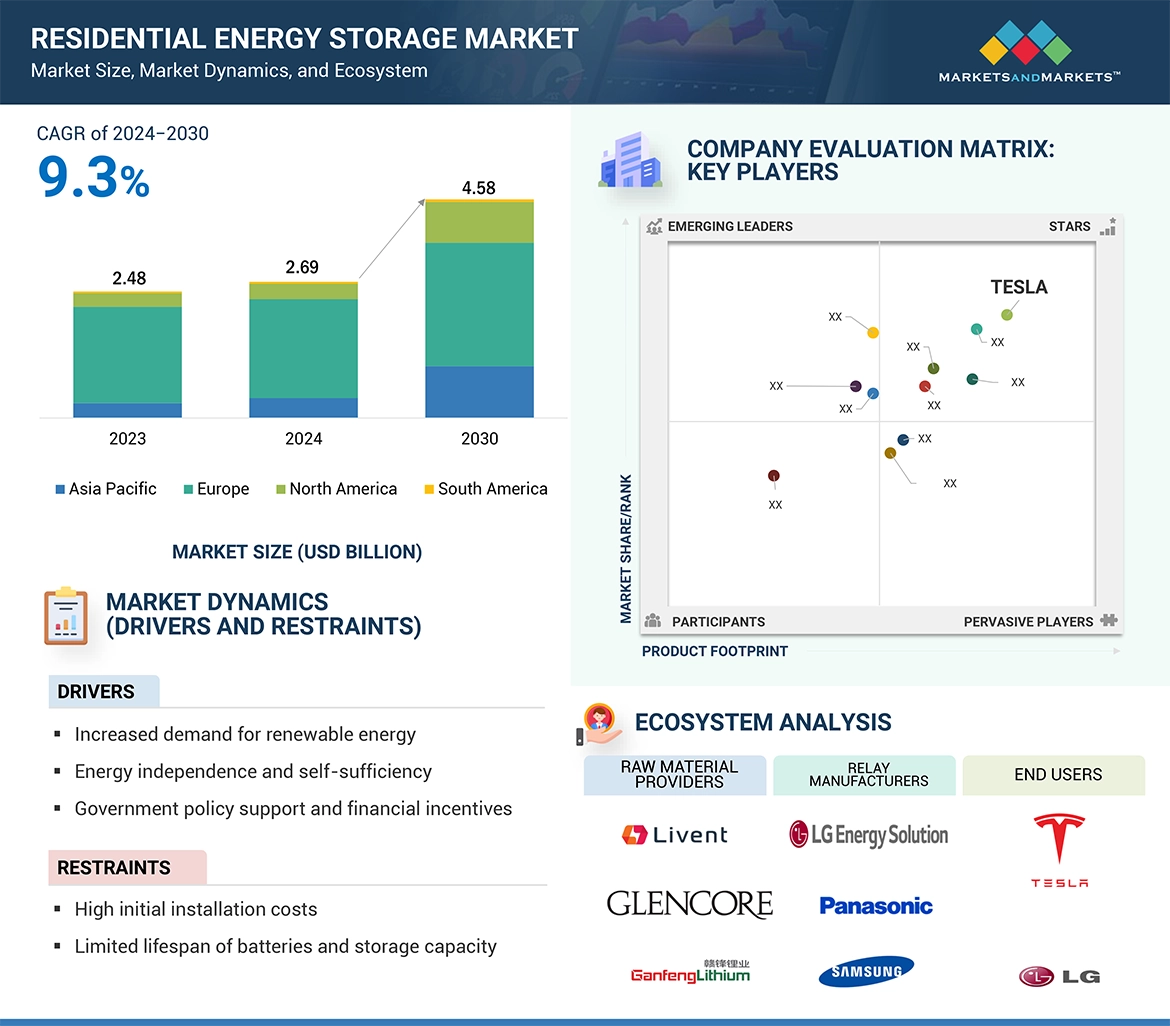
The global Residential Energy Storage Market is anticipated to grow from estimated USD 2.67 billion in 2024 to USD 4.30 billion by 2030, at a CAGR of 8.2% during the forecast period. Rapid developments in battery technologies, especially in lithium-ion systems, have led to cost decline at levels that see energy storage systems increasingly come closer to the residential customer. Improvements in manufacturing processes as well as an economy of scale combined with growing competition in the energy storage industry mainly contributed to the cost decrease. Thus, what is previously too expensive for most consumers was possible for homeowners to invest in and hence more widely adopted. In addition, modern batteries have better energy density, longer lifespans, and more efficiency, pushing their cost-effectiveness toward households in terms of reliable, long-term energy-demand management. This pattern serves to promote a systematic transition toward sustainable energy systems while also promoting the integration of renewable sources, such as solar power, into housing energy frameworks.

Download PDF Brochure: https://www.marketsandmarkets.com/pdfdownloadNew.asp?id=153284325

Customer owned, by ownership type

Rising grid electricity tariffs have made household energy expenses scale, compelling homeowners to seek low-cost alternatives. Residential energy storage systems serve as a useful solution whereby users can store energy when prices are low and use them during peak hours when the prices are relatively higher. Energy storage also reduces the dependence of this power on utility companies thereby cushioning the homeowner against the continual fluctuation of energy prices. This would hold particularly true in regions with dynamic pricing models or where high energy costs are experienced, where the economic benefits of self-sufficiency become more pronounced.
Residential Energy Storage Market

Standalone systems, by operation type

With awareness of climate change, homeowners are increasingly motivated to minimize their reliance on fossil fuels. Energy storage systems and renewable energy sources, built solely but combined with solar and wind sources, prove very effective in reducing household carbon emissions. These systems enable homeowners to power their homes with clean, renewable energy, even in instances of low generation and high demand by holding excess energy generated during the day or favourable weather conditions. This change benefits the energy future to become more sustainable and supports the requirements for the overall environmental goals set globally and personal aspirations for sustainability besides cutting down greenhouse emissions.

Europe is expected to be the largest region during the forecast period. 

Rising electricity prices in the European region have provided a strong economic motivation for homeowners to seek residential energy storage solutions. With this typical growth and increase in energy prices, the consumers are on a lookout for solutions that can help them cushion the impact of erratic utility bills. Energy storage systems, especially when combined with solar energy production, will enable households to store excess power generated during off-peaking times and use them as needed during peak demand periods, thereby reducing their dependence on the grid. Indeed, a shift like this promises instant benefits-when it comes to savings in energy bills-but long-term financial advantages, also: by cushioning the rise in electricity costs.

Further support for the growing adoption of such systems is brought about by the promise of self-sufficiency. Households increasingly see energy storage as part of an overarching strategy to make sure that stable and affordable energy will remain when this unstable market situation prevails. Considering that energy prices are expected to maintain their levels over the next few years, the return for residential storage is becoming clearer, and thus it’s a smart move for those wishing to optimize their energy usage and minimize ongoing costs.

Key Players

Some of the major players in the Residential Energy Storage Market are Panasonic Holdings Corporation (Japan), Tesla (US), Sonnen GmbH (Germany), BYD Company Ltd. (China), and Enphase Energy (US) among others. The major strategies adopted by these players include new product launches, acquisitions, joint ventures, and expansions.

Request Sample Pages: https://www.marketsandmarkets.com/requestsampleNew.asp?id=153284325

Panasonic Holdings Corporation

Panasonic Holdings Corporation, is the industry leader in the Residential Energy Storage Market, with very advanced lithium-ion battery technology and innovative energy solutions. Its EverVolt systems come with modular scalability, smart energy management, and reliable backup power that allows households to maximize energy usage and carbon footprints. With its strong presence in the global markets of the US, Japan, and Europe, Panasonic also utilizes its worldwide partnerships and brand recognition to secure an edge in sustainable, high-quality energy storage solutions. For this reason, combined with its development plan for carbon neutrality and investments in R&D, Panasonic will continue to play a large role in the emerging need for residential energy management.

TESLA

TESLA is a leader in the Residential Energy Storage Market due to the revolutionary Powerwall system that flows smoothly with solar energy options to deliver safe, scalable, and sustainable energy storage. Building on this deep knowledge of advanced lithium-ion battery technology combined with cost efficiency at the Gigafactories, Tesla proffers high-performance solutions that are globally accessible. Advanced features like real-time energy monitoring, backup power support, and modular expandability realize the growing interest in smart and energy-independent homes focused on sustainability. One of Tesla’s strategic initiatives in boosting the adoption of widespread battery systems has been particularly successful in North America, Europe, and Australia. These markets place emphasis on renewable energy and a resilient grid. Good brand recognition for the company combined with favorable dynamics at the market place and supportive policies by the government makes the company the leader in driving renewable energy. Tesla continues to innovate in battery technologies and redefining household consumption, thus taking a strong position in the global transition to sustainable energy solutions.

BYD Company Ltd

BYD Company Ltd, is another leader in residential energy storage. The company is famous for its highly advanced lithium iron phosphate (LFP) battery technology. The company offers safe, durable, and thermally stable solutions. Its vertically integrated supply chain and modular products, such as the Battery-Box Premium series, provide scalable and cost-efficient energy storage tailored to residential needs. It has an outstanding global footprint, excellent partnerships and seam-free integrability with renewable energy systems like solar PV. Thus, BYD is better posed to maintain an edge despite growing competition and pressure on supply chains. Its focus on sustainability and innovation will ensure its pivotal role in advancing the transition of the global energy equation.

For more information, Inquire Now!

Wednesday, December 11, 2024

Hydrogen Energy Storage Market Projections: Europe in Focus

Hydrogen Energy Storage Market – Europe Market Scenario

According to a latest research, The global hydrogen energy storage market is estimated to grow from USD 11.4 billion in 2023 to USD 196.8 billion by 2028; it is expected to record a CAGR of 76.8% during the forecast period.

The European hydrogen energy storage market is an emerging sector within the global market that is expected to grow significantly due to the rise in fuel cell adoption, strict regulations related to emission control, and the inclination toward cleaner fuels.

Download PDF Brochure: https://www.marketsandmarkets.com/pdfdownloadNew.asp?id=107179995

The European countries have their energy policies in various phases of development, while the EU region has set a binding target for reducing greenhouse gas (GHG) emissions by at least 40% by 2030 compared to the level in 1990. This is a rather ambitious goal as the EU sets out to fight climate change, transition to renewable energy sources, and stimulate sustainable economic growth. Implementation of such policies will demand sizeable investments in clean technologies and infrastructure towards the implementation of these emission control targets. In addition, fuel cells are expected to witness rapid adoption due to the increasing number of fuel cell projects and government initiatives that are being implemented in the residential and commercial sectors. Fuel cells, an efficient and clean energy alternative, are suitable solutions to address the energy challenges faced in the region. The Fuel Cells and Hydrogen Joint Undertaking initiative is the primary body that supports R&D in fuel cells and hydrogen technologies in Europe. Increasing demand for electric vehicles is also expected to boost the fuel cells market in this region, in turn, driving the hydrogen energy storage market. Therefore, an increase in FCEVs and HRS is expected to fuel the growth of the hydrogen energy storage market in the European region.

The growth in renewable energy sources, such as wind and solar, demands the production of efficient energy storage technology, like hydrogen, to level out the generation. Besides, Hydrogen production, storage, and fuel cell technologies are constantly improving their feasibility and economics for hydrogen energy storage systems. Besides storage, hydrogen will be used in transport, heating, and industrial applications. This positions Hydrogen high on fashion for energy plans with long-term commitments. More importantly, hydrogen storage facilities would also provide mutual sharing of surplus renewable energies between the countries and also ease inter-balancing of each other's power grids.  

Make an Inquiry: https://www.marketsandmarkets.com/Enquiry_Before_BuyingNew.asp?id=107179995

With several promising projects at hand and different R&D studies, hydrogen energy storage has begun to present much promise in the European region. For example, ENGIE is one of the leaders in the low-carbon energy and services markets. It has led to the transition towards clean and sustainable energy solutions. The central element of this strategy has emerged as hydrogen energy storage. In January 2021, ENGIE and TotalEnergies, an energy company and petroleum company, signed a cooperation agreement to develop, build, and operate the Masshylia project, France's largest renewable hydrogen production site at Châteauneuf-les-Martigues in the South region. An advanced management approach will be implemented to manage the production and storage of hydrogen. Thus, future hydrogen storage projects and investments are likely to boost the hydrogen energy storage market.

There are several players headquartered in European countries that offer hydrogen energy storage, such as ENGIE, Storelectric LTD, Mahytec, HPS Home Power Solutions AG, and HDF ENERGY, among others, for various applications such as stationary power and transportation. To establish a strong product portfolio for hydrogen energy storage, these companies adopt strategic developments such as collaboration, agreements, and contracts, among others. Mahytec specializes in designing and manufacturing hydrogen storage systems. The company offers compressed to solid hydrogen storage solutions through hydrides. Its solutions are used in stationary applications and projects with transport or on-board systems. It provides comprehensive solutions that fully comply with international standards. Mahytec has a strong R&D potential that helps it provide innovative solutions to its customers. Similarly, HPS Home Power Solutions AG is also one of the prominent European companies that specializes in providing hydrogen fuel cell solutions. The company offers HPS Picea, which provides electricity storage, heating support, and ventilation in living spaces. Its products are used in commercial and residential buildings. In October 2021, in June 2021, the company entered a sales partnership agreement with Energieinsel GmbH. Under this agreement, Energiensel GmbH includes HPS products in its product portfolio. It has a regional footprint in Europe. Such strategic partnerships will boost the hydrogen energy storage market in the Europe.  

Ask Sample Pages of the Report: https://www.marketsandmarkets.com/requestsampleNew.asp?id=107179995

The expansion of hydrogen energy storage in the European market is being driven further due to its efficient, decentralized method of energy storage, raising the security of energy through energy independence from fossil fuels to enable local energy production, and the European Union also provides financial support along with regulatory frameworks and further research funding for the application and development of hydrogen energy storage technologies. Besides, public awareness of the environmental benefits of hydrogen energy storage and its potential in combating climate change is enhancing acceptance and demand across Europe. These are the potential drivers responsible for fostering the hydrogen energy storage market in Europe.

Tuesday, December 10, 2024

DERMS Market Latest Trends, Development, Growth Analysis And Forecast by 2029

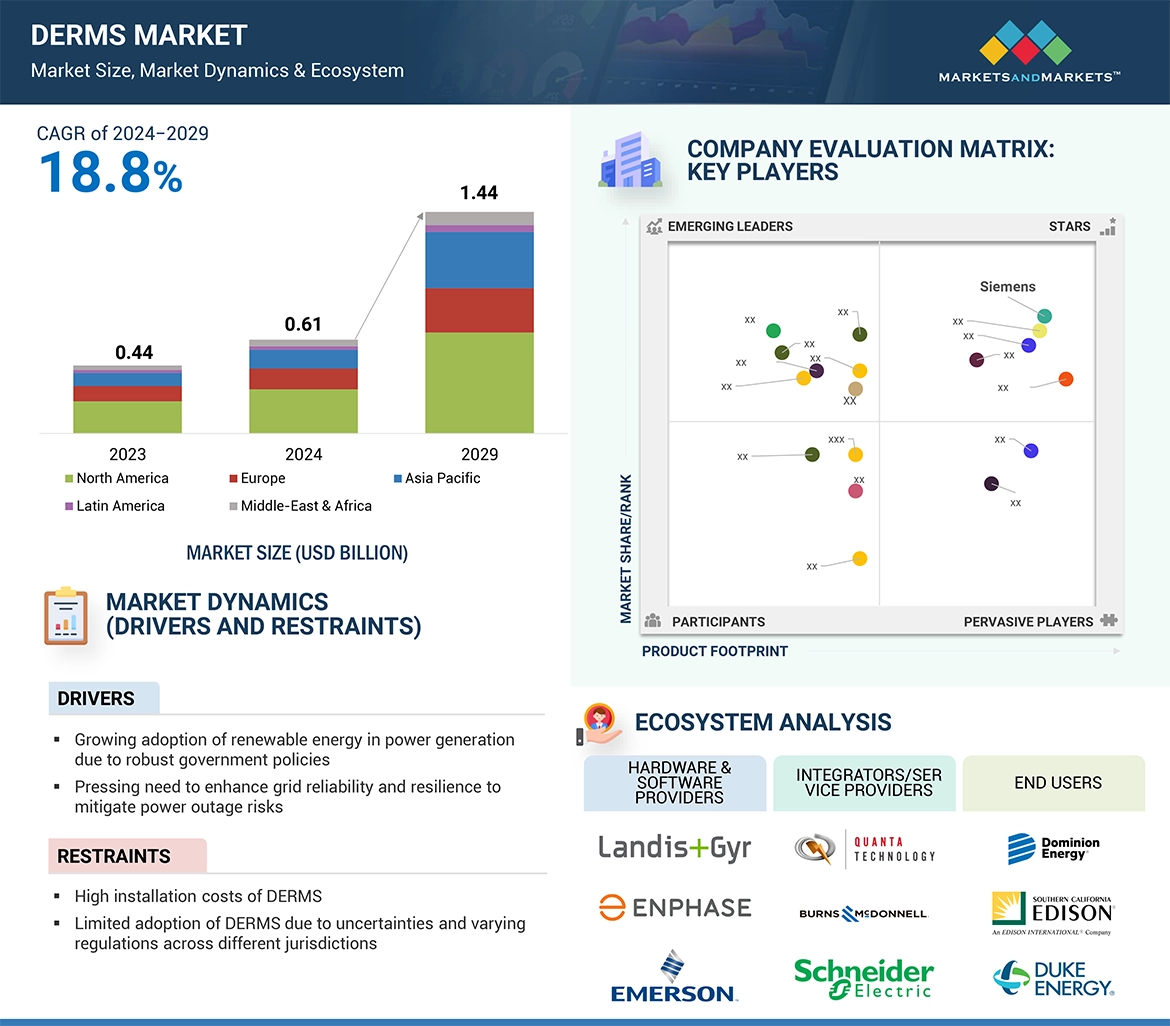
According to a research report "DERMS Market by Offerings (Software, Services), Application (Solar PV Systems, Wind Energy Systems, Energy Storage, Combined Heat & Power Systems, EV Charging Solutions), End-User (Residential, Commercial, Industrial) & Region - Global Forecast to 2029" published by MarketsandMarkets, the Distributed energy resource management systems (DERMS) market is expected to grow from an estimated in USD 0.61 billion in 2024 to USD 1.44 billion by 2029, at a CAGR of 18.8% during the forecast period. The market for DERMS is thus growing rapidly. Some of the key factors driving the market are increased adoption of renewable energy sources such as solar and wind power, which are considered significant for the improvement of grid reliability and efficiency. Such a rise is being driven by increased environmental concerns, advances in technology, and government policies that encourage clean energy solutions. Meanwhile, significant investment in smart grid infrastructure and the increasing digitization of energy systems would further spur market growth.

Download PDF Brochure:

https://www.marketsandmarkets.com/pdfdownloadNew.asp?id=256436187

Industrial, by end-user, is expected to be the largest market during the forecast period

Industrial end-user sector dominates the DERMS market, outweighing the commercial and residential segments due to the sheer volume of power consumed in this sector and its critical need for efficient energy management. Manufacturing, mining, and heavy engineering industries require reliable cost-effective power solutions to continue operations at reduced energy costs. Benefits for industries include the optimization of energy consumption, resource integration from renewable sources, and stability of the grid. All this is important in minimizing downtime and ensuring sustainability. Moreover, industrial installations generally have larger budgets and infrastructure readiness to implement DERMS than the commercial and residential sectors, which makes them the leaders in this market.

DERMS Market

Solar PV, by Application, is expected to be the largest segment during the forecast period.

The Application segment is further segmented into 6 types: Solar PV Systems, Wind Energy Systems, Energy Storage, Combined Heat & Power Systems, EV Charging Solutions, Other Applications. Solar PV  segment is expected to drive the market. The large-scale adoption of solar energy around the world has made it a major source of renewable resources. Their scalability, cost-effectiveness, and clean mode of energy generation have made them highly popular across industrial, commercial, and residential sectors. Also, DERMS play a critical role in optimizing the integration of solar PV systems into the grid, managing variability in generation, and ensuring grid stability. Other drivers of solar PV dominance in the DERMS market include supportive government policies, declining solar panel costs, and the increasing demand for decentralized energy solutions.

Asia Pacific is expected to be the fastest-growing region during the forecast period.

Asia-Pacific is the largest growing region in the DERMS market due to rapid industrialization, urbanization, and increasing energy demand. In addition, regions strongly focus on the adoption of renewable energy, especially solar and wind. Therefore, DERMS becomes necessary for the efficient integration of distributed energy resources into the grid. These policies, subsidies, and investments in smart grid infrastructure by governments in countries like China, India, and Japan are promoting increased energy reliability and sustainability. Furthermore, the region's market growth is further augmented by the penetrating growth of advanced technologies and increasing end-user awareness about energy efficiency.

Make an Inquiry:

https://www.marketsandmarkets.com/Enquiry_Before_BuyingNew.asp?id=256436187

Key Players

Some of the major players in the DERMS market Siemens (Germany), General Electric Company (US), Schneider Electric (France), ABB (Switzerland), and Hitachi, Ltd. (Switzerland), among others. The major strategies adopted by these players include new product launches, acquisitions, joint ventures, and expansions.

Thursday, December 5, 2024

Lithium Iron Phosphate Batteries Market Recent Developments & Emerging Trends To 2028

According to a research report "Lithium Iron Phosphate Batteries Market size - Global forecast to 2028" , the global lithium iron phosphate batteries market is projected to reach USD 35.5 billion by 2028 from an estimated USD 17.7 billion in 2023, at a CAGR of 14.9% during the forecast period.

Lithium Iron Phosphate (LiFePO4) batteries, also known as LFP batteries, are a type of rechargeable lithium-ion battery chemistry. They are composed of a cathode made of lithium iron phosphate and an anode made of carbon. LiFePO4 batteries are known for their high energy density, long cycle life, and excellent thermal stability. The market growth of LFP is driven by substantial need for battery-operated material-handling equipment. Transition from conventional power generation to renewable generation present promising opportunities for the lithium iron phosphate batteries market. However, the risks associated with disposal of spent lithium-based batteries has hindered the growth of the market in recent years and is expected to restrain the market's growth during the forecast period.

Download PDF Brochure:

https://www.marketsandmarkets.com/pdfdownloadNew.asp?id=77659282

The 50,001–100,000 mAh, by capacity

Based on capacity, the lithium iron phosphate batteries market has been split into 0–16,250 mAh; 16,251–50,000 mAh; 50,001–100,000 mAh and 100,001–540,000 mAh. 50,001–100,000 mAh capacity batteries are expected to grow at the highest CAGR during the forecasted period. These batteries are used in industries where high power capacity is required. Major applications include EVs, plug-in HEVs, uninterrupted power supply, wind energy storage, electric robot, electric mower, solar energy storage, vacuum cleaner, golf cart, telecom, marine, defense, mobile, and floor machines. The types of batteries made for such high-power applications include lithium iron phosphate, lithium manganese oxide, lithium titanium oxide, and nickel manganese cobalt, and some are made in modular formats. Besides the modular format, the other formats include polymer, prismatic, energy storage systems, and battery packs.

The high segment, by voltage

This report segments the lithium iron phosphate batteries market based on voltage into three segments: low (Below 12V), medium (12–36V), and high (Above 36V). The high voltage segment is expected to be the largest segment during the forecast period. These high-voltage batteries are used for powering heavy electric vehicles, industrial applications, power backup, HEVs, energy storage systems, emergency power systems, microgrids, yachts, military, and marine applications. The batteries cannot be made of a single cell and hence require a module and sometimes an array of modules, power racks, power containers, and others. These systems can be made using lithium manganese oxide, lithium iron phosphate, nickel manganese cobalt, and lithium titanium oxide. The rising sustainability concerns and the consequent transition toward the adoption of EVs are expected to influence the adoption of these batteries, consequently increasing the demand.

Regional Analysis

Asia Pacific is expected to be the largest lithium iron phosphate batteries market during the forecast period. The Asia Pacific region, comprising major economies such as China, India, Japan, South Korea, and the Rest of Asia Pacific, which have a huge potential for several application areas within the lithium iron phosphate. In recent years, this region has emerged as a hub for automobile production. Recent infrastructure developments and industrialization activities in emerging nations have opened new avenues and opportunities for OEMs. Additionally, the increasing purchasing power of the population has stimulated the demand for automobiles, which would be a driving force for the growth of the lithium iron phosphate batteries market. Asia-Pacific region has a significant presence in the lithium-ion battery industry, both in terms of battery production and demand. Countries, particularly China, South Korea, and Japan, are major manufacturers of lithium-ion batteries. These countries have a well-established battery industry, with large-scale production facilities operated by companies such as BYD Company Ltd, CATL, CALB, LG Chem, and few other key players. They produce batteries for a wide range of applications, including electric vehicles, consumer electronics, and energy storage systems.

Some of the major players in the lithium iron phosphate batteries market are BYD Company Ltd. (China), Contemporary Amperex Technology Co., Limited. (China), Gotion, Inc. (US), CALB (China), and A123 Systems LLC (US). The major strategies adopted by these players include product launches, contracts, agreements, and expansions.

About MarketsandMarkets™
MarketsandMarkets™ has been recognized as one of America’s best management consulting firms by Forbes, as per their recent report.
MarketsandMarkets™ is a blue ocean alternative in growth consulting and program management, leveraging a man-machine offering to drive supernormal growth for progressive organizations in the B2B space. We have the widest lens on emerging technologies, making us proficient in co-creating supernormal growth for clients.
Earlier this year, we made a formal transformation into one of America's best management consulting firms as per a survey conducted by Forbes.
The B2B economy is witnessing the emergence of trillion of new revenue streams that are substituting existing revenue streams in this decade alone. We work with clients on growth programs, helping them monetize this trillion opportunity through our service lines - TAM Expansion, Go-to-Market (GTM) Strategy to Execution, Market Share Gain, Account Enablement, and Thought Leadership Marketing.
Contact:
Mr. Rohan Salgarkar
MarketsandMarkets Inc.
1615 South Congress Ave.
Suite 103, Delray Beach, FL 33445
USA: +1-888-600-6441
Email: newsletter@marketsandmarkets.com

Tuesday, December 3, 2024

Inverter Market Size to Surpass USD 39.6 Billion by 2028, exhibiting a CAGR of 16.0%

According to a latest research report, The Inverter market size is projected to reach USD 39.6 billion by 2028 from an estimated USD 18.9 billion in 2023, at a CAGR of 16.0% during the forecast period. The inverter market is experiencing rapid growth driven by several factors. Increased adoption of renewable energy sources, such as solar and wind power, necessitates inverters to convert generated direct current (DC) into usable alternating current (AC). Technological advancements have enhanced inverter efficiency and affordability, making them integral in diverse applications like residential solar installations, electric vehicles, and industrial machinery. Additionally, the growing demand for uninterrupted power supply and the expansion of smart grids contribute to the market surge. As energy needs evolve towards sustainability and efficiency, the inverter market continues to expand, meeting the demands of a changing energy landscape.

key trends

Increased adoption of renewable energy, technological advancements that improve efficiency, integration into energy storage systems, the emergence of smart features, the popularity of string inverters and microinverters, the development of hybrid inverter systems, contributions to grid modernization, and increased demand for electric vehicles. Manufacturers are also focusing on efficiency improvements and cost reductions to help with the overall transition to sustainable energy solutions.

Make an Inquiry: https://www.marketsandmarkets.com/Enquiry_Before_BuyingNew.asp?id=263171818

This report segments the Inverter market based on inverter type into: solar inverter, vehicle inverter and others. The vehicle inverter segment is expected to be the largest segment in Inverter market in the forecast period. The global need for vehicle inverters is increasing due to the growing popularity of electric cars (EVs). EVs are gaining popularity as the automobile industry swings towards electrification in order to address environmental concerns and lessen reliance on traditional fossil fuels. Vehicle inverters are critical components in electric propulsion systems, converting direct current (DC) from the battery to alternating current (AC) for the electric motor. The growing global demand for EVs is creating a corresponding surge in demand for car inverters to facilitate the move to cleaner, more sustainable transportation.

This report segments the Inverter market by output voltage, has been segmented into 100–300 V, 300–500 V, and Above 500 V. 100-300V is expected to be the fastest growing segment in the market expanding rapidly due to its versatility in covering a wide range of energy requirements. This voltage range is ideal for a variety of applications, including domestic solar installations, where inverters with this output range efficiently convert the generated direct current (DC) from solar panels to usable alternating current (AC). As global demand for distributed energy generation and residential solar systems grows, the 100-300V category meets the needs of these applications, contributing to its position as the fastest-growing market segment in the inverter industry.

Key Stakeholders

  • Energy utilities
  • Government and research organizations
  • Institutional investors
  • Investors/shareholders
  • Process industries and power and energy associations
  • Public and private operators of power plants
  • Inverter manufacturers, dealers, and suppliers

Request Sample Pages of the Report: https://www.marketsandmarkets.com/requestsampleNew.asp?id=263171818

Numerous interrelated reasons are driving the market for inverters, which is expanding significantly. As renewable energy sources like solar and wind power become more widely used, inverters become more and more necessary to convert DC energy into AC. Increased use of electric vehicles and other forms of electrification accelerates the need for inverters in powertrains and charging infrastructure. Continuous technical developments extend the functionality and efficiency of inverters, increasing their use in a variety of industries. Furthermore, the need for inverters in the residential, commercial, and industrial sectors is driven by the growing emphasis on energy efficiency as well as the necessity for a steady supply of electricity. The inverter market is expanding as sustainability and the energy transition become more and more important worldwide.

Browse Trending Reports

Lithium Iron Phosphate Batteries Market – Global Forecast to 2028

Residential Energy Storage Market – Global Forecast to 2028

Waste Management Market Major Developments and Competition Landscape by 2029

The Global   Waste Management Market   is projected to reach USD 1598.1 billion by 2029 from an estimated USD 1219.6 billion in 2024, at a C...